In an era of deep political polarization and fragmented media consumption, the way Americans engage with their communities, their government, and their news sources has become increasingly distinct. A groundbreaking analysis from the Pew Research Center, conducted under the auspices of the Pew-Knight Initiative, has unveiled a compelling correlation between how individuals participate in public life and the news outlets they choose to follow.
By categorizing Americans into four unique "engagement groups"—Mobilizers, Connectors, Spectators, and Outsiders—researchers have mapped the intersection of civic behavior and media consumption. The findings suggest that the most civically active Americans are disproportionately represented in the audiences of specific, high-profile news organizations, while the news habits of less engaged groups mirror a broader, more generalized pattern of media consumption.
Defining the Four Engagement Archetypes
To understand the relationship between public life and news habits, the Pew Research Center analyzed data from 30 prominent media sources. The research relies on a comprehensive cluster analysis, which sorted U.S. adults into four segments based on 19 specific metrics, including political activity, civic and volunteer participation, religious attendance, and general attention to news.
1. The Mobilizers: The Political Engines
The Mobilizers are the most engaged group, though they represent the smallest portion of the population (approximately 9%). This segment is hyper-active across all measured categories: they vote, they volunteer, they attend religious services, and they follow the news with high intensity. They are essentially the primary drivers of political and civic discourse in the United States.
2. The Connectors: Socially Active, Politically Reserved
Larger than the Mobilizers, the Connectors are highly involved in their communities—frequently joining local groups and making charitable donations—but they are markedly less interested in direct political combat. Their engagement is anchored in social and community cohesion rather than partisan struggle.
3. The Spectators: Passive Observers
Spectators are defined by their high consumption of news. They "keep an eye on things" by following current events closely, but they are significantly less likely than the previous two groups to participate directly in political or community activities.

4. The Outsiders: The Disengaged Majority
Representing the final, and largest, cohort, the Outsiders are characterized by low participation in almost every measured area. They are the least likely to vote, volunteer, or follow the news, reflecting a segment of the public that remains largely disconnected from the traditional mechanisms of civic and political life.
Chronology of the Research Effort
The data presented in this analysis was gathered through a rigorous, multi-phased approach, reflecting the complexity of modern social science research.
- March 2025: The Pew Research Center initiated a survey of 9,482 U.S. adults to establish a baseline of news habits. Participants were asked to identify which of 30 major news sources they recognized and which they consumed on a regular basis.
- July 2025 – December 2025: A separate, non-panel survey of 5,393 adults was conducted to refine the criteria for civic engagement. This process involved testing the 19 measures of participation that would eventually define the four engagement groups.
- September 2025: A follow-up survey of 5,195 adults (including a subset of 4,476 who participated in the March study) was conducted to map the specific news-source preferences of the newly defined engagement groups.
- November 2026: The final analysis was synthesized and published by the Pew-Knight Initiative, offering a comprehensive look at how these distinct behavioral groups filter into the media landscape.
Supporting Data: The Media-Engagement Correlation
The data confirms a stark reality: media consumption is not random. It is an extension of an individual’s broader civic identity.
The Mobilizer Bias in Political Media
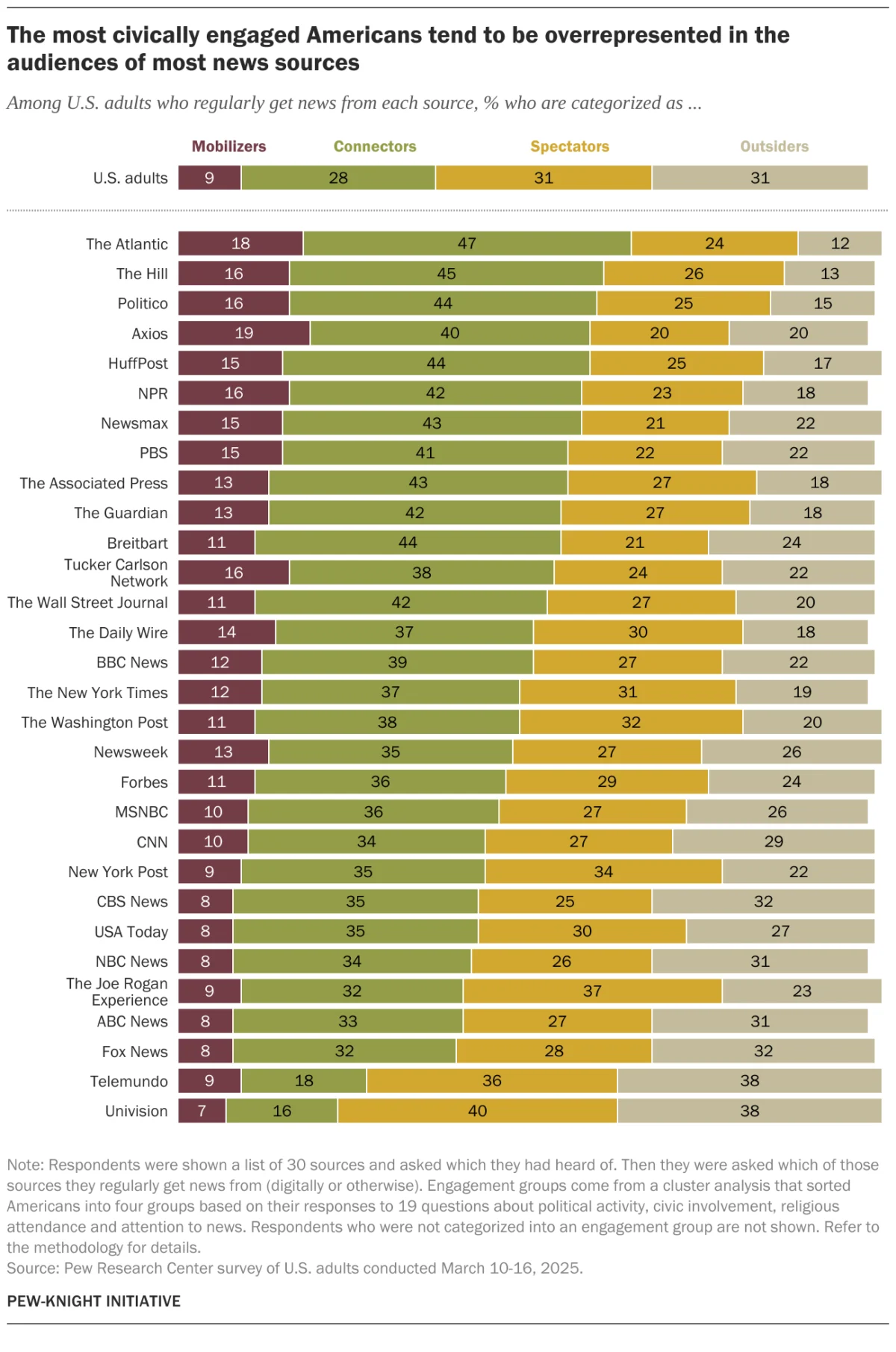
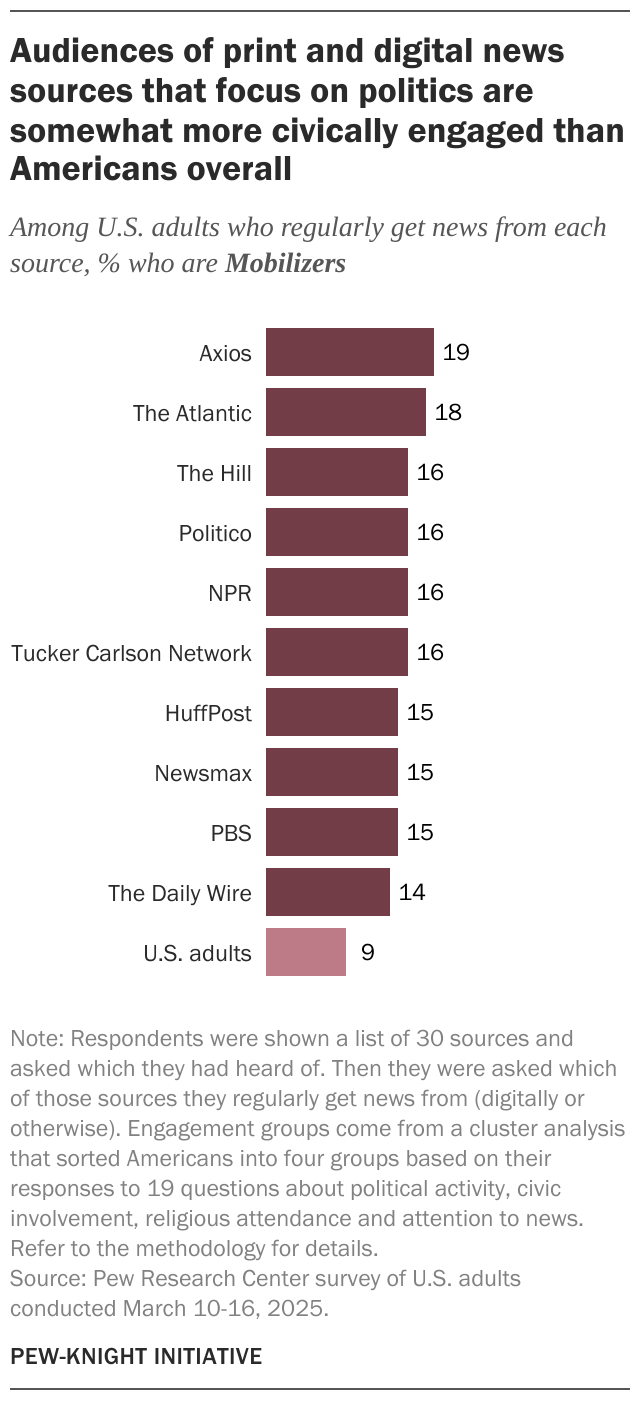
News outlets that prioritize deep-dive political coverage tend to attract a significantly higher percentage of Mobilizers than the national average. For instance, while only 9% of the total U.S. population qualifies as a Mobilizer, they account for 19% of the regular audience for Axios. Similarly, The Atlantic (18%), The Hill (16%), and Politico (16%) draw audiences that are nearly double the national concentration of these hyper-engaged citizens. Public media outlets like NPR (16%) and PBS (15%) also show a clear affinity for this demographic.
The "Outsider" Prevalence in Traditional Broadcast
Conversely, the "Outsiders"—those least involved in civic life—are found in greater numbers among traditional broadcast news networks. While 31% of the U.S. population are classified as Outsiders, that same percentage is found in the audiences of ABC News and NBC News. Spanish-language networks Telemundo and Univision have an even higher concentration of Outsiders (38%), highlighting a unique demographic and civic profile within these specific audience bases.
The Connector Influence
Connectors appear to be a ubiquitous force in media. They are overrepresented across nearly all of the 30 sources studied. For example, nearly half (47%) of The Atlantic’s audience consists of Connectors, as does 45% of The Hill’s audience. Their willingness to engage in community and group-based activities appears to translate into a higher-than-average appetite for news, even if their primary interest lies outside of pure political campaigning.

Official Perspectives and Methodology
The Pew Research Center emphasizes that this analysis was designed to illuminate the relationship between identity, participation, and information. By utilizing the American Trends Panel (ATP), the researchers ensured that the data remained representative of the full U.S. adult population.
"We did this analysis to better understand how these behaviors—voting, volunteering, following the news, and taking part in religious or community activities—relate to one another," the report notes. The Center further clarified that respondents who could not be categorized into one of the four engagement groups were excluded from the final comparative charts, ensuring that the findings reflect the core tendencies of the identified segments.
The collaboration with the Knight Foundation highlights a shared goal: fostering more informed and engaged communities. By identifying that "news consumption is among the factors we used to build these categories," the report acknowledges a circular relationship—civic engagement leads to higher news consumption, which in turn reinforces civic engagement.

Broader Implications for Democracy
The implications of these findings are profound for the media landscape and the health of the American republic.
The Echo Chamber Effect
The overrepresentation of "Mobilizers" in political-heavy outlets suggests that the most active citizens are curating their information in environments that likely validate their high-intensity engagement. This can lead to a deepening of ideological divides, as the primary consumers of political news are the very people most likely to be engaged in the polarizing aspects of political life.
The Challenge of the "Outsider"
Perhaps more concerning for the democratic process is the status of the "Outsiders." With 31% of the population falling into this category, there exists a large segment of the electorate that is not only disengaged from political and civic activities but also less likely to be reached by the news media. When this segment does interact with the media, it is often through channels that do not necessarily bridge the gap between their daily lives and the broader political discourse.
The Role of Localized and Community Media
The high concentration of "Connectors" in various media outlets suggests that there is a significant audience for journalism that focuses on community-building and social connectivity. Media organizations that pivot toward this type of reporting may find a receptive audience among those who are tired of partisan politics but remain deeply committed to their local communities.
Conclusion
The Pew-Knight Initiative’s research offers a sobering, yet vital, roadmap for understanding the modern American audience. We are no longer a monolith of information consumers; we are a collection of engagement archetypes. Whether one is a "Mobilizer" seeking to influence the levers of power, or an "Outsider" navigating life on the fringes of political participation, the news we consume is both a reflection of our civic identity and a potential tool for shaping it.
As media organizations grapple with declining trust and shifting business models, this data suggests that the path forward may involve understanding not just what their audience wants to read, but how their audience chooses to live. By tailoring content to the specific engagement profiles of their readers—whether that is the political intensity of the Mobilizer or the community-focused nature of the Connector—news organizations may be able to better serve a citizenry that is increasingly defined by how it participates in the life of the nation.