WASHINGTON — For decades, the digital infrastructure powering the modern internet hummed quietly in the background. Housed in windowless industrial parks and nondescript suburban warehouses, data centers were viewed by local municipalities as clean, quiet corporate neighbors that brought steady tax revenue without the smoke, noise, or heavy truck traffic of traditional manufacturing.
Today, that quiet coexistence has shattered. Fueled by an unprecedented, breakneck expansion of artificial intelligence (AI) infrastructure, data centers have transformed from invisible utilities into ground zero for one of the most widespread grassroots environmental and political movements of the decade.
Data compiled by the Pew Research Center reveals a dramatic shift in public sentiment. In the 2026 midterm elections, voters in at least 38 jurisdictions across the United States passed ballot measures explicitly designed to limit, restrict, or outright ban new data centers. What began as localized grumbling over flickering lights and rising electricity bills has evolved into a formidable national referendum on the physical footprint of the digital age.
Main Facts: The Scope and Scale of the Expansion
The friction between local communities and big tech is fundamentally a collision of math, geography, and electrical capacity. As tech giants race to train ever-more complex large language models, the infrastructure required to support these operations has expanded at a staggering rate.
According to data compiled in early 2026:
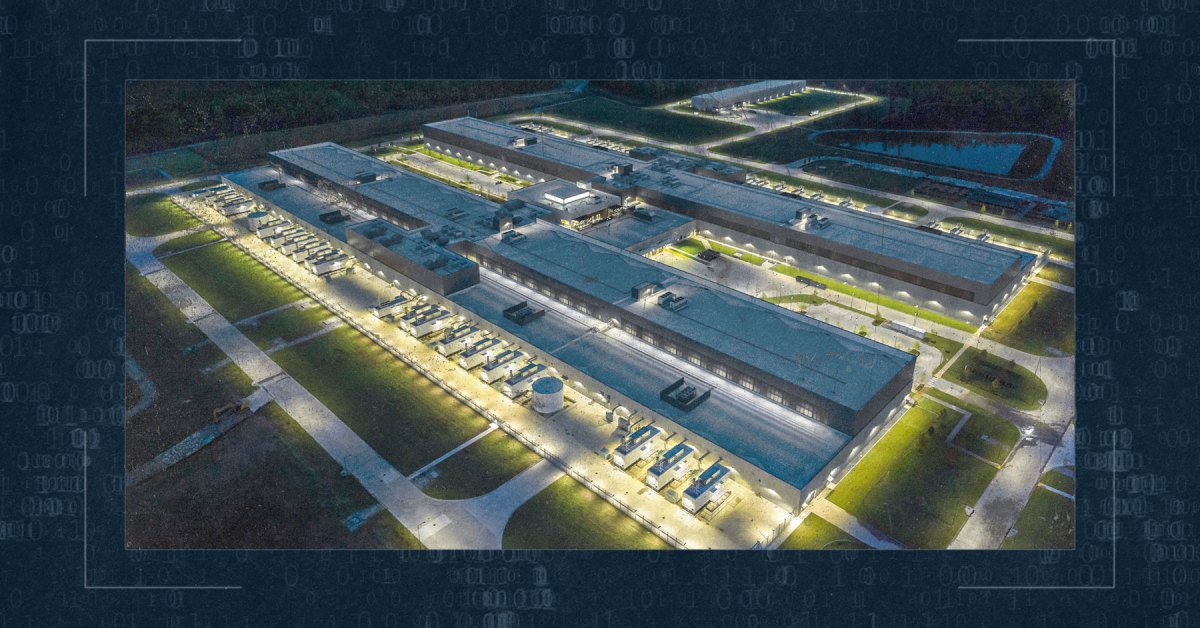
- The Operational Footprint: There were more than 3,000 operational data centers in the United States as of February 2026, with an additional 1,500 facilities in various stages of development, planning, or land-banking.
- Geographic Concentration: Existing facilities remain heavily clustered. Approximately 87% of operational data centers are located in urban areas, and 89% sit within 5 miles of another data center.
- The Rural Pivot: The next wave of expansion, however, is shifting outward. Two-thirds of all planned data centers are slated for rural areas, and 39% are planned for counties that currently have no data center presence at all.
- Proximity to the Public: Roughly 42% of U.S. adults live within 5 miles of an existing or planned data center. This includes 38% living near an operational facility and 4% near a planned site.
State-Level Leaders
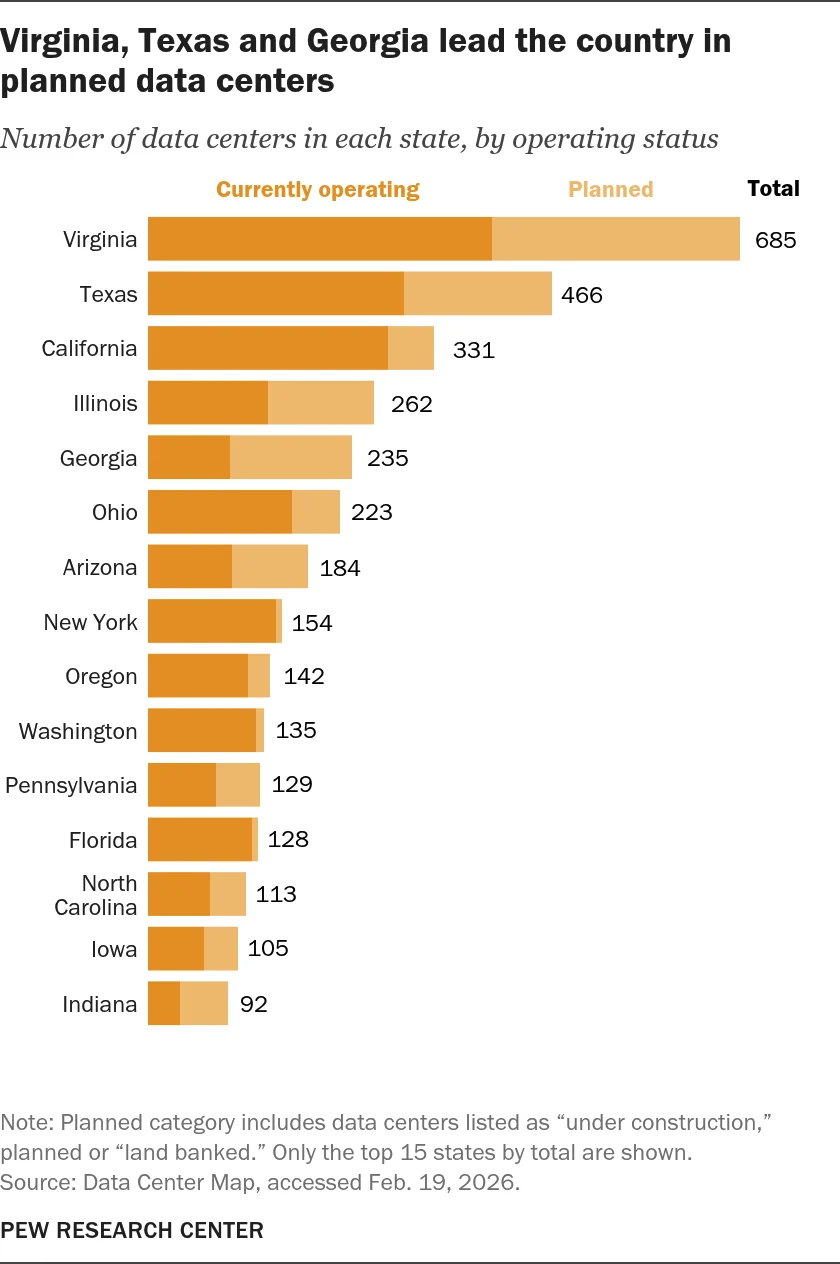
Nationwide, nine states housed 100 or more operational data centers as of February 2026. Virginia leads the nation by a wide margin, anchoring 398 operating facilities and 287 planned projects. Texas follows with 296 operating and 170 planned centers, while California hosts 277 operating and 54 planned facilities.
In Northern Virginia, Loudoun County remains the undisputed capital of this industry—globally recognized as "Data Center Alley"—due to its unprecedented density of server farms. However, states like Illinois, Georgia, Ohio, and Arizona are experiencing massive influxes of new construction to meet computational demands.
Chronology: The Trajectory of the Backlash
The rapid escalation of public resistance to data centers did not happen overnight; it is the product of a compressed timeline defined by explosive technological growth and sudden resource strains.

- 2020–2024 (The Quiet Acceleration): Driven by cloud computing and early generative AI development, U.S. data center electricity consumption surges. According to International Energy Agency (IEA) figures, domestic data center energy use jumps from 108 terawatt-hours (TWh) in 2020 to 183 TWh in 2024—surpassing the total data center electricity consumption of Europe (68 TWh) and the entire Asia-Pacific region (150 TWh) combined. Together, the U.S. and China account for 69% of global data center electricity use by 2024.
- October 2025 (The Energy Reality Check): Public awareness crystallizes around resource consumption as analyses reveal that data centers devour over 4% of the entire U.S. electricity supply. In states like Virginia, data centers consume roughly 26% of the state’s total electricity supply, bringing grid capacity issues into sharp public focus.
- January to March 2026 (Early Skepticism): Polling data from early 2026 indicates that Americans are beginning to connect the dots between massive server farms and their household expenses. A March survey shows that among Americans experiencing rising home energy bills, roughly two-thirds blame the surging energy consumption of data centers as a major or minor factor.
- Summer 2026 (The Sentiment Tipping Point): Between January and August 2026, Pew Research Center surveys document a dramatic souring of public opinion. The percentage of U.S. adults who view data centers as "mostly bad" for the environment jumps from 39% to 54%. Those viewing them as mostly bad for home energy costs rises from 38% to 50%, while concerns regarding local quality of life climb from 30% to 49%.
- Fall 2026 (Political Repercussions): Discontent spills over into the political sphere. Fall polling reveals that 58% of U.S. adults dislike political leaders who support building data centers locally, compared to just 9% who view them favorably.
- November 2026 (The Midterm Referendum): Voters in at least 38 jurisdictions across the country utilize the ballot box during the midterm elections to officially pass restrictive measures, zoning blocks, and moratoriums against data center developments.
Supporting Data: What Americans Think
The depth of public resistance is underscored by comprehensive polling data gathered across multiple demographic and geographic segments. Despite industry arguments regarding economic stimulus, public skepticism remains remarkably uniform.
Public Perception of Data Center Impacts (% "Mostly Bad")
| Topic | January 2026 | August 2026 |
|---|---|---|
| The Environment | 39% | 54% |
| Home Energy Costs | 38% | 50% |
| Quality of Life Nearby | 30% | 49% |
| Local Jobs | 15% | 24% |
| Local Tax Revenue | 12% | 21% |
Local Comfort Levels
When asked about their comfort level with a new data center operating in their immediate area, 60% of U.S. adults stated they would be "not too" or "not at all comfortable." Only 7% indicated they would be extremely or very comfortable, while 19% reported being somewhat comfortable, and 12% were unfamiliar with the facilities.
Crucially, this discomfort is not confined to NIMBYism in wealthy suburbs or rural enclaves. Majorities across all community types express deep reservation:
- Urban Residents: 57% uncomfortable
- Suburban Residents: 63% uncomfortable
- Rural Residents: 60% uncomfortable
Partisanship offers little refuge for data center developers either. While Democrats and Democratic-leaning independents express higher levels of discomfort (68%) compared to Republicans and Republican-leaning independents (54%), majorities within both political coalitions lean negative. Furthermore, bipartisan agreement is clear when evaluating political leadership: 69% of Democrats and 49% of Republicans view local politicians who champion data center expansion with disfavor.

Official Responses: Industry, Utilities, and Local Governments
The collision between multi-trillion-dollar tech enterprises and local municipalities has forced utilities, state regulators, and industry leaders into a defensive posture.
For years, tech companies pitched data centers as economic engines that would fund local schools and infrastructure through property and tax revenues. While local officials initially welcomed these promises, the sheer scale of modern AI workloads has strained municipal planning departments. Facilities that once required a few megawatts now demand hundreds of megawatts—equivalent to the power draw of medium-sized cities.
Utility companies, facing unprecedented demand spikes, have increasingly been forced to delay the retirement of fossil-fuel plants or seek out controversial new power sources—including restarting dormant nuclear reactors—to keep pace with tech sector demands. This has placed municipal governments in a difficult bind: balancing the lucrative tax incentives offered by tech giants against the immediate, vocal fury of constituents facing grid instability and climbing utility bills.
In response to the November 2026 ballot measures, industry trade groups have emphasized their commitment to sustainability, pointing to corporate investments in renewable energy procurement, advanced liquid cooling technologies, and closed-loop water systems designed to minimize community resource drain. However, critics argue that these corporate promises do little to mitigate the immediate noise pollution, heavy construction disruption, and localized grid strain experienced by host communities.

Implications: The Future of AI Infrastructure in America
The events of 2026 mark a critical inflection point for the artificial intelligence revolution. The bottleneck for AI development is no longer exclusively about silicon chip availability or algorithmic breakthroughs; it is increasingly a question of siting, power, and social license.
Several long-term implications emerge from this growing friction:
- The Decentralization and Offshoring Pressure: As zoning boards, county commissioners, and voters in traditional tech hubs slam the door on new builds, developers are being forced to look further afield. This may accelerate the push into remote rural regions or prompt tech companies to look internationally toward nations with less stringent local democratic oversight or more robust national energy grids.
- Regulatory and Legislative Hurdles: The success of ballot initiatives in 38 jurisdictions signals that local zoning battles will become standard operational hazards for big tech. State legislatures will increasingly find themselves caught between aggressive economic development agendas and populist anti-datacenter movements.
- The Energy Transition Paradox: Perhaps the most profound irony of the data center backlash is its impact on climate goals. To power the massive computational clusters required for the AI boom, tech companies are scouring the market for clean energy. Yet, the sheer volume of power consumed threatens to overwhelm renewable energy additions, driving up consumer utility costs and sparking environmental backlash from communities who see their local ecosystems strained to power algorithms used half a world away.
As the United States pushes further into the artificial intelligence era, the central question remains unresolved: Can the digital infrastructure of the future be built in a way that coexists peacefully with the communities that host it, or will the physical weight of the cloud continue to spark a grassroots revolt across the American landscape?