
NEW YORK — "We came to this place for magic."
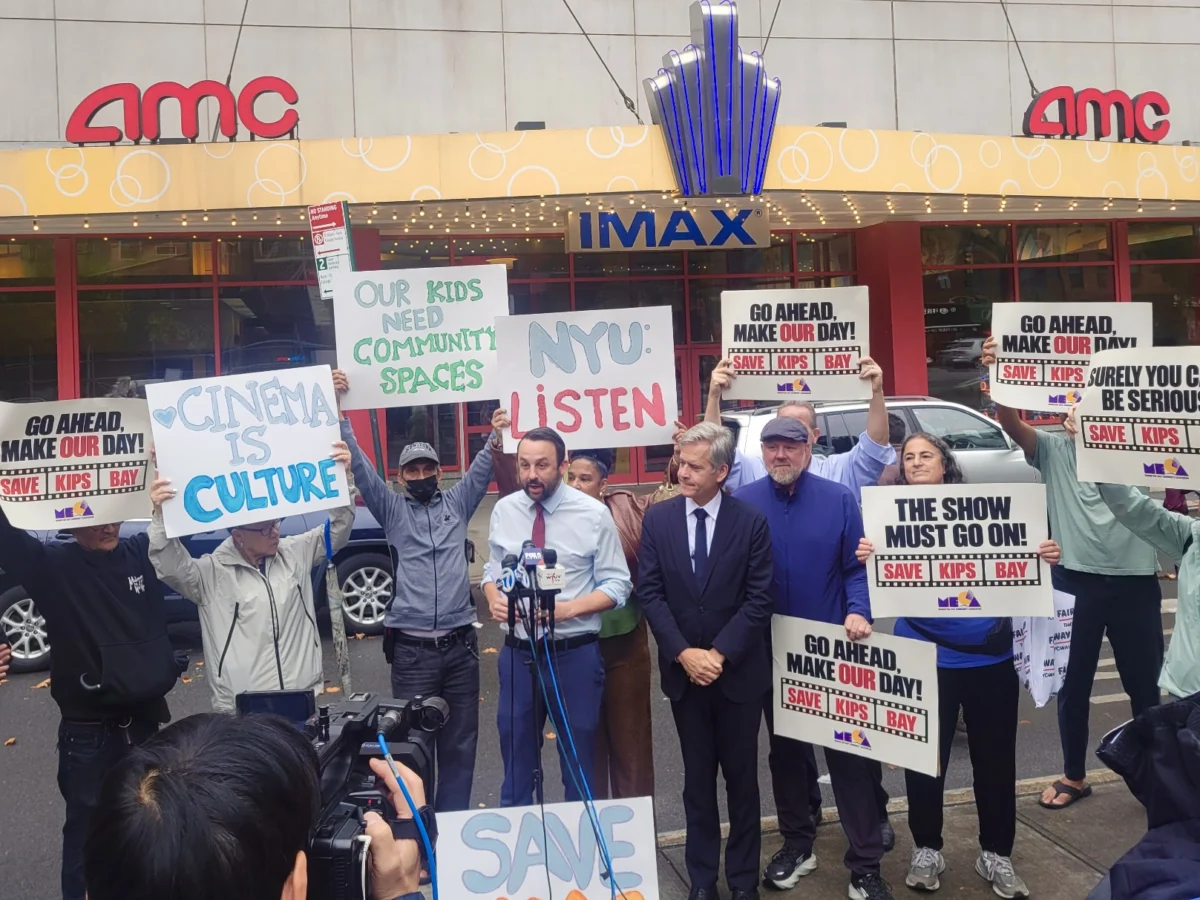
On a brisk, rainy Sunday afternoon, those iconic words—famously delivered by Nicole Kidman in AMC Theatres’ ubiquitous pre-show commercials—echoed through the concrete canyons of Manhattan’s East Side. Manhattan Borough President Brad Hoylman-Sigal, standing outside the AMC Kips Bay 15, channeled his best Australian accent to recite the familiar line. It was equal parts performance art and emotional plea, delivered in loving tribute to a neighborhood cultural institution facing an imminent, unceremonious fade to black.
Despite a record-breaking summer at the box office that proved the enduring public appetite for the theatrical experience, the sprawling Kips Bay multiplex is expected to close its doors permanently by the end of the year. The closure threatens to erase a vital anchor of community life, sparking fierce resistance from local residents, small business owners, and high-ranking city officials who are drawing a direct line between local real estate overreach and broader corporate consolidation across the entertainment landscape.
Main Facts: The Battle for AMC Kips Bay
The looming shuttering of the AMC Kips Bay 15—the second-largest movie theater chain multiplex in the borough of Manhattan—is more than just a routine commercial lease expiration. It represents a flashpoint in the ongoing friction between institutional expansion and neighborhood preservation in New York City.
The property housing the multi-screen theater was privately acquired over a year ago by NYU Langone Health, one of the city’s most aggressive and expansive medical and educational institutions. While the real estate transaction was finalized behind closed doors, public awareness of the theater’s fate has only recently crystallized, setting off a wave of civic activism.
The "Save the Kips Bay AMC Theater Rally," held on that damp Sunday, drew more than 100 passionate New Yorkers. From lifelong neighborhood mainstays to Gen-Z cinephiles, the crowd underscored that the multiplex is far more than a commercial enterprise; it is a shared living room for a densely populated district where public gathering spaces are rapidly vanishing.
Chronology: How the Kips Bay Closure Unfolded
To understand how a thriving neighborhood staple arrived at the brink of extinction, one must look at the timeline of events that caught local leadership and residents entirely off guard.
- Over a Year Ago: NYU Langone quietly completes the private purchase of the land and building housing the AMC Kips Bay multiplex. Details of the transaction and long-term plans for the site are kept out of public view.
- Late 2025/Early 2026: Whispers of the theater’s impending demise begin to circulate among community boards and local film enthusiasts, coinciding with broader national anxieties over theater industry health despite strong seasonal box-office numbers.
- Weeks Prior to the Rally: City and state officials publicly acknowledge that they were left out of the loop regarding the acquisition, discovering the buyout only after the ink had dried.
- Sunday Afternoon: The Eleanor Roosevelt Independent Democrats organize the "Save the Kips Bay AMC Theater Rally." Over 100 demonstrators, joined by Manhattan Borough President Brad Hoylman-Sigal and State Senator Kristen Gonzalez, gather outside the theater to voice their opposition.
- Post-Rally (Present Day): Local businesses, such as the historic Paddy Reilly’s Music Bar, throw their weight behind the preservation effort, offering promotions to rally attendees as community pressure mounts on both AMC Theatres and NYU Langone.
- End of 2026 (Projected): The expected final date of operation for the AMC Kips Bay 15 multiplex, barring any eleventh-hour intervention or lease renegotiation.
Supporting Data: Community Stakes and Economic Realities
The resistance to the Kips Bay closure is underpinned by stark demographic and economic realities. Manhattan has steadily lost independent and commercial neighborhood movie theaters over the past two decades, victims of skyrocketing rents, shifting streaming habits, and aggressive corporate real estate development.
For the Kips Bay community, the loss of the 15-screen theater strips the neighborhood of its primary entertainment anchor. Unlike boutique art-house cinemas downtown, the Kips Bay location offers scale, accessibility, and mainstream cinematic experiences that cater to a wide cross-section of New Yorkers—from families and college students to elderly residents.
Furthermore, the economic ripple effects extend directly to surrounding small businesses that rely on the foot traffic generated by moviegoers. Paddy Reilly’s Music Bar, an Irish staple located just around the corner, is celebrating its 40th year in business. Recognizing the symbiotic relationship between the pub and the theater, owner Desi Murray mobilized his clientele to support the protest.
"It’s very important because we have a lot of young people in this neighborhood who love to go to the movie theater," Murray noted, reflecting on his three years owning the establishment. Following the rally, Paddy Reilly’s offered a free drink to anyone who visited with a selfie from the protest, turning a neighborhood grievance into an act of communal solidarity. Inside the pub, patrons reminisced about decades of cinematic history, noting that a theater has stood on or near that footprint for generations.
Official Responses: Transparency and Community Engagement
The manner in which the Kips Bay transition was handled has drawn sharp rebukes from elected officials who feel blindsided by institutional power plays.
New York State Senator Kristen Gonzalez voiced deep frustration over the lack of proactive communication from NYU Langone, a neighbor with which local government entities have historically collaborated on numerous fronts.
"NYU is a neighbor, and we’ve worked with them in many different capacities, so it was surprising that we had to reach out to them to find out that they were the ones looking to acquire the land behind us," Gonzalez explained in an interview following the protest. "It’s not unreasonable to ask NYU to be proactive in engaging with the community."
Judith Gross, president of the Eleanor Roosevelt Independent Democrats—a political club representing the Lower East Side, East Village, and Midtown East—echoed those sentiments. Her members, she noted, were "devastated" by the news but remain determined to make their voices heard by corporate and institutional decision-makers.
"I’m hoping AMC and NYU see what we’ve done here," Gross said. "This neighborhood is not a campus for NYU and its medical offices. We’re guiding the whole community to protest these takeovers of what little community space we have left."
Implications: From Local Real Estate to Hollywood Boardrooms
While the fight to save the AMC Kips Bay 15 is fundamentally a hyper-local real estate battle, participants and observers argue it is symptomatic of a much larger, systemic issue plaguing modern society: the systematic erosion of public spaces and consumer choice in favor of consolidated corporate power.
Elected officials and cultural critics are drawing direct parallels between the stealthy acquisition of the Kips Bay multiplex and massive corporate shake-ups rippling through the entertainment industry, such as the high-profile Paramount-Warner Bros. merger. Critics of that media consolidation have argued that corporate mega-deals ultimately diminish opportunities and resources for independent creatives, reduce consumer choice, and prioritize balance sheets over cultural enrichment.
"And right here, the same thing is happening," Senator Gonzalez observed, linking the macro-level corporate maneuvers in Hollywood to the micro-level realities of urban development. "We’re getting a big new partner coming in, potentially kicking this out, limiting options to see the movies in our neighborhood. And all we’re asking for, whether it’s in Hollywood or right here in New York, is for everyday people to be included and have our voices heard."
As the clock ticks down toward the end of the year, the fate of the Kips Bay AMC remains precariously balanced. Whether public pressure can alter the trajectory of a multi-million-dollar real estate acquisition remains to be seen. However, the mobilization outside the theater’s doors has made one thing abundantly clear: the residents of Kips Bay will not let their cinematic sanctuary slip away quietly into the dark.