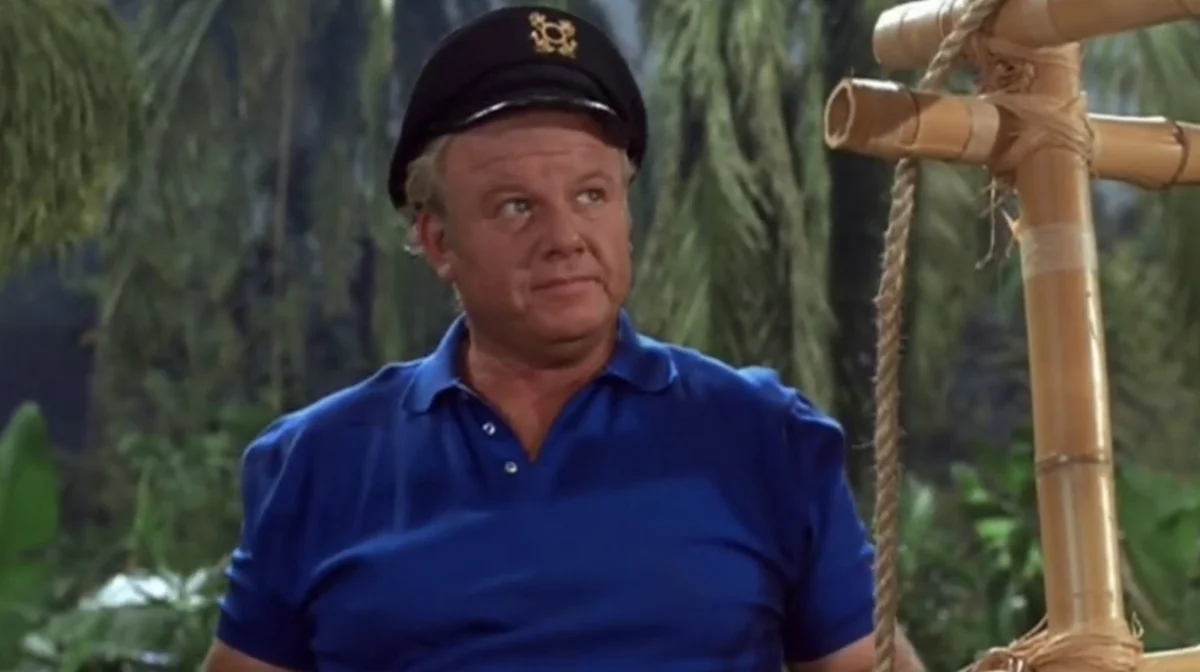
In the annals of television history, few casting stories are as legendary—or as harrowing—as that of Alan Hale Jr. securing his role as Jonas “The Skipper” Grumby on the seminal sitcom Gilligan’s Island. While the character of the blustery, lovable captain of the S.S. Minnow is now synonymous with mid-century American pop culture, the actor behind the hat almost missed his chance at immortality entirely. It was a sequence of events involving a remote desert set, a horse, a hitchhiked ride, and a flight from Las Vegas that serves as a testament to both Hale’s professional grit and the serendipitous nature of Hollywood success.
The Call from the Mojave: A Casting Conundrum
By the early 1960s, Alan Hale Jr. was a working actor of significant pedigree. The son of character actor Alan Hale Sr., he had spent years carving out a niche in Westerns and adventure films. However, his career trajectory shifted irrevocably when he caught wind of a new project from producer Sherwood Schwartz: a sitcom about a group of disparate travelers shipwrecked on a deserted island.
At the time the casting call went out, Hale was miles away from the glitz of CBS studios. He had committed to a role in a low-budget film shooting in the unforgiving terrain of the Mojave Desert. In a 1988 interview on Fox’s The Late Show, Hale recounted the logistical nightmare of receiving the invitation to audition while stranded in the wilderness.
“It was kind of a difficulty as to how was I going to get there,” Hale admitted to the host. “There were no planes out of there, there were no rental cars or anything.”
Chronology of a Cross-Country Trek
The journey to stardom for Hale began with an act of sheer desperation. Recognizing that the role of The Skipper was a once-in-a-lifetime opportunity, he refused to let his geographic isolation be the reason he lost the part.
- The Desert Departure: Faced with no modern transportation, Hale navigated his way from the movie set to the nearest highway by horseback. This primitive mode of transit was a fitting, if ironic, beginning for the man who would eventually spend years pretending to navigate the treacherous waters of the Pacific.
- The Hitchhiker’s Gamble: Once he reached the outskirts of St. George, Utah, Hale resorted to the oldest trick in the book: sticking out his thumb. He successfully hitchhiked his way to Las Vegas, a journey that stripped away the veneer of Hollywood glamour, leaving him at the mercy of the open road.
- The Final Sprint: Upon arriving in Las Vegas, Hale managed to secure a flight to Los Angeles. He landed at the CBS studios just in the nick of time, disheveled but undeterred.
This odyssey was more than just a commute; it was a physical manifestation of the same determination his character, The Skipper, would eventually display while attempting to manage his unruly crew and the perpetually inept Gilligan.
Destined for the Helm: Sherwood Schwartz’s Vision
When an exhausted Alan Hale Jr. finally walked into the casting office, he wasn’t just auditioning for a role—he was walking into a part that had, in many ways, been written with his specific persona in mind.
Sherwood Schwartz, the visionary creator behind Gilligan’s Island, recognized the fit almost immediately. As Hale recalled, Schwartz told him, “Alan, in many ways, I have written this story for you. If you’d like to be The Skipper, you are, but I would like to see you in contrast with some of the people that we’re going to use.”
The "chemistry read" that followed became the foundational moment for the series. The producers needed to ensure that the relationship between the authoritative, if easily frustrated, Skipper and the childlike, accident-prone Gilligan, played by Bob Denver, would resonate with audiences. The immediate rapport between Hale and Denver was undeniable. It was the birth of a comedic dynamic that would anchor the show for three seasons and keep it in syndication for decades to follow.
Supporting Data: The Physics of Slapstick
To understand why the casting of Alan Hale Jr. was so vital, one must look at the technical requirements of the show’s comedy. Gilligan’s Island was, at its core, a physical comedy. It relied on the kinetic energy between its ensemble, and specifically the interplay between the imposing Skipper and the spindly Gilligan.
Bob Denver, reflecting on the success of the series in an interview featured in The New York Times following Hale’s death in 1990, provided a vivid description of their working relationship:
"[Alan Hale Jr.] was a great guy and a great physical comic. He was so strong that I could run across the stage, and he could catch me like a feather. That’s what made our comedy so great."
This physical strength was a crucial, often overlooked, element of the show’s success. Hale’s ability to handle the slapstick nature of the scripts—the falls, the scuffles, and the constant physical exasperation—provided the stability that allowed Denver’s Gilligan to shine. Without Hale’s physical stature and his willingness to participate in the physical rigors of the role, the comedic timing of the show’s most famous sequences would have likely collapsed under the weight of its own ambition.
Official Responses and Historical Context
The impact of Hale’s casting went beyond the immediate production. In the years following the show’s 1967 cancellation, critics and fans alike have noted that Gilligan’s Island occupied a unique space in television history. It was a show that bridged the gap between the Vaudevillian roots of physical comedy and the modern sitcom format.
Schwartz’s decision to cast Hale was not merely about filling a vacancy; it was a deliberate choice to ground the absurdity of the island in a character who felt both formidable and vulnerable. Official studio records from the era suggest that the producers were looking for someone who could balance "commanding authority" with "underlying warmth," a set of traits that Hale possessed in spades.
Implications: The Legacy of a Castaway
The implications of Hale’s difficult journey to the set are profound. Had he been unable to leave the Mojave, the character of The Skipper would have been played by a different actor—one who might not have possessed the same physical dexterity or the same natural chemistry with Bob Denver.
Would the show have lasted three seasons? Would it have become the global cultural phenomenon it remains today? The historical consensus points toward a resounding "no." The specific, lightning-in-a-bottle dynamic of the original cast is what allowed the show to survive even when faced with harsh critical reviews during its original run.
Furthermore, Hale’s commitment to the role remained steadfast long after the cameras stopped rolling. He famously embraced the character for the rest of his life, often appearing in character at restaurants and public events, much to the delight of fans. His dedication was a mirror of the journey he took to get the part: once he was in, he was fully committed to the voyage.
Conclusion: The Skipper Lives On
The story of Alan Hale Jr.’s path to Gilligan’s Island is a classic piece of Hollywood lore that highlights the unpredictable nature of the entertainment industry. It reminds us that behind every iconic performance is a human story—a tale of effort, timing, and a bit of luck.
From riding a horse out of the desert to hitching a ride to stardom, Hale’s journey was the perfect prelude to his life on the island. He arrived at the CBS studios not as an actor looking for a paycheck, but as a performer ready to inhabit a role that would define his legacy. Today, more than 50 years after the S.S. Minnow first set sail, the legend of the actor who hitchhiked his way to the skipper’s chair remains a cornerstone of television history—a reminder that sometimes, the best adventures happen on the way to the set.