In the quiet suburbs and bustling city centers of the United States, a nearly invisible infrastructure of high-speed cameras is silently documenting the movement of millions of citizens. These devices, known as Automated License Plate Readers (ALPRs), are not the bulky, roof-mounted sensors of the past. They are sleek, solar-powered, and ubiquitous. At the center of this technological revolution is Flock Safety, a private firm founded in 2017 that has rapidly become the dominant force in public safety surveillance.
As of late 2026, the reach of these cameras has expanded to include over 100,000 nodes across the country, creating a digital map of where Americans go, when they get there, and how often they pass through specific neighborhoods. While proponents argue that the technology is a game-changer for solving violent crime, critics, privacy advocates, and a growing number of lawmakers are raising alarms about the potential for systemic abuse, turning the spotlight on a tool that has effectively turned the American street into a continuous surveillance loop.
The Evolution of the Digital Dragnet: A Chronology
The roots of modern license plate tracking stretch back to the mid-1970s in the United Kingdom. Initially designed by the Police Scientific Development Branch to combat terrorism and track vehicles associated with the Irish Republican Army, the technology was rudimentary by today’s standards. It required massive computing power and grainy, black-and-white photography.
By the early 2000s, as processing speeds increased and camera costs plummeted, ALPRs began to proliferate across the United States. However, these early iterations were largely limited to patrol cars. The real shift occurred in 2017, when the startup Flock Safety entered the market. By moving the hardware from the roof of a police cruiser to a fixed, elevated pole, Flock allowed for continuous, 24/7 data collection on every vehicle that passed by.
The company’s growth was exponential. By 2025, Flock reported that its systems had assisted in over 1 million law enforcement investigations. This rapid scaling, however, has outpaced the legal frameworks intended to protect civilian privacy. As reports of officers using the vast network of cameras to stalk ex-partners or engage in personal investigations surfaced in 2026, the narrative surrounding the technology shifted from "public safety essential" to "regulatory crisis."
The Geography of Surveillance: Where the Cameras Live
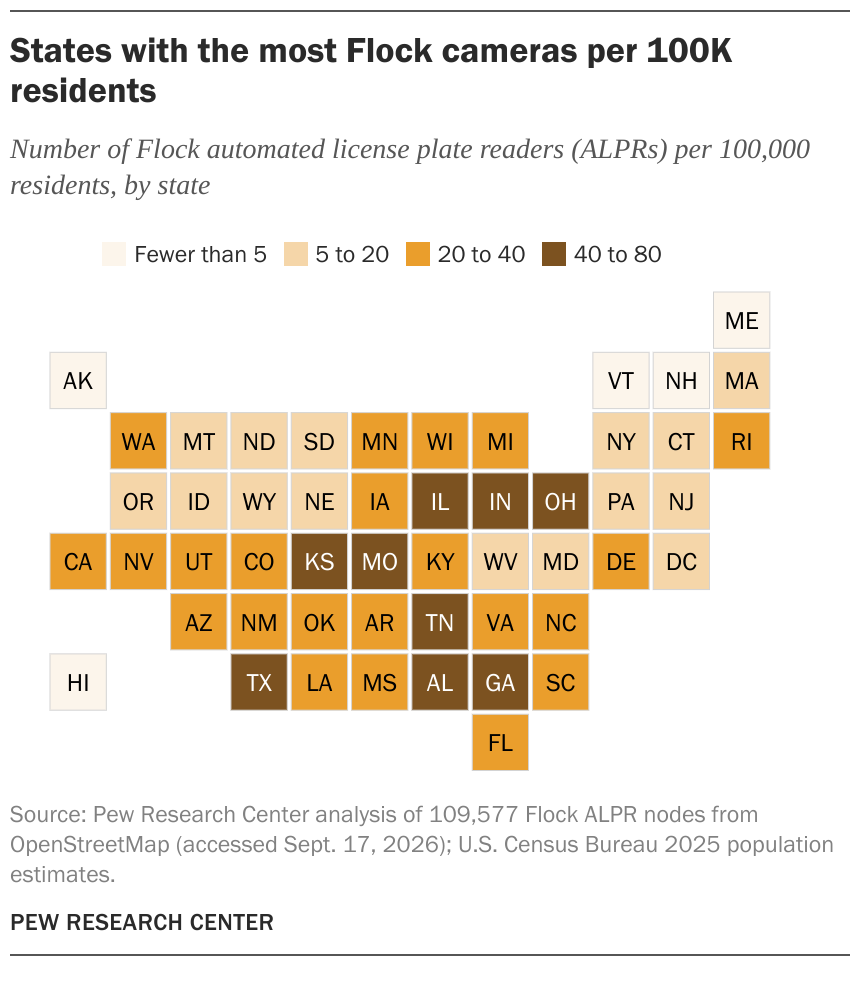
Pew Research Center’s recent analysis, which utilized crowdsourced data from OpenStreetMap, provides the most comprehensive look to date at the concentration of these devices. The findings suggest that the deployment of these cameras is far from uniform.
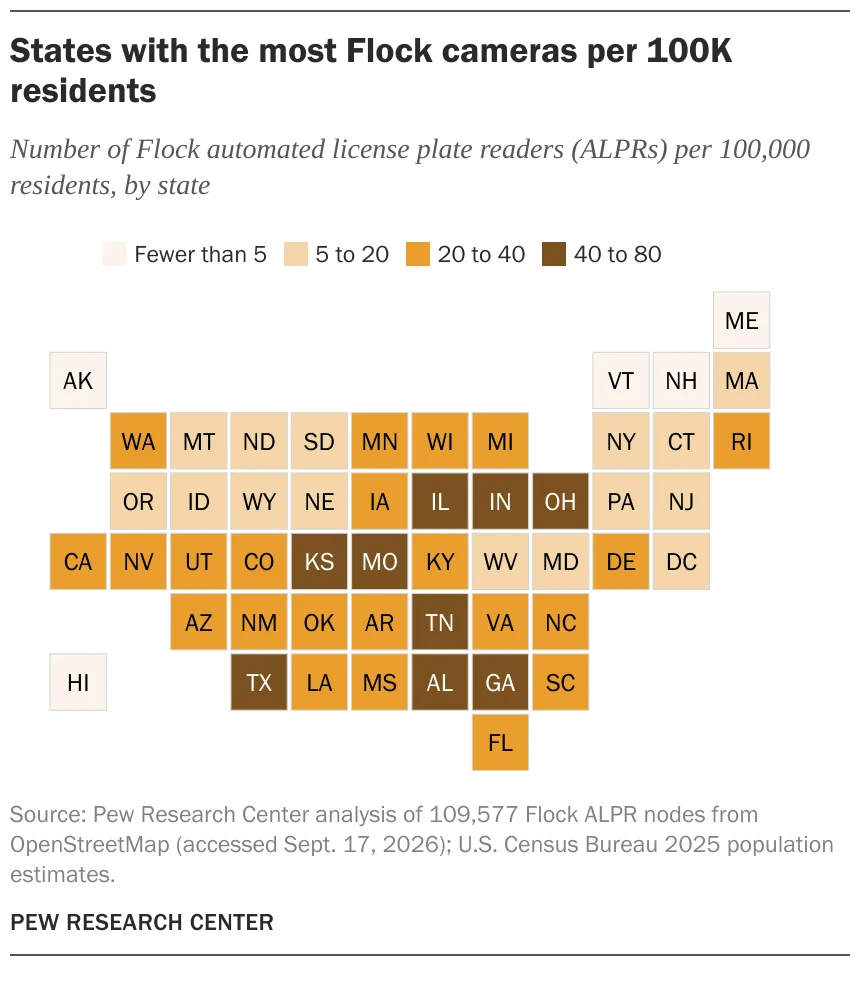
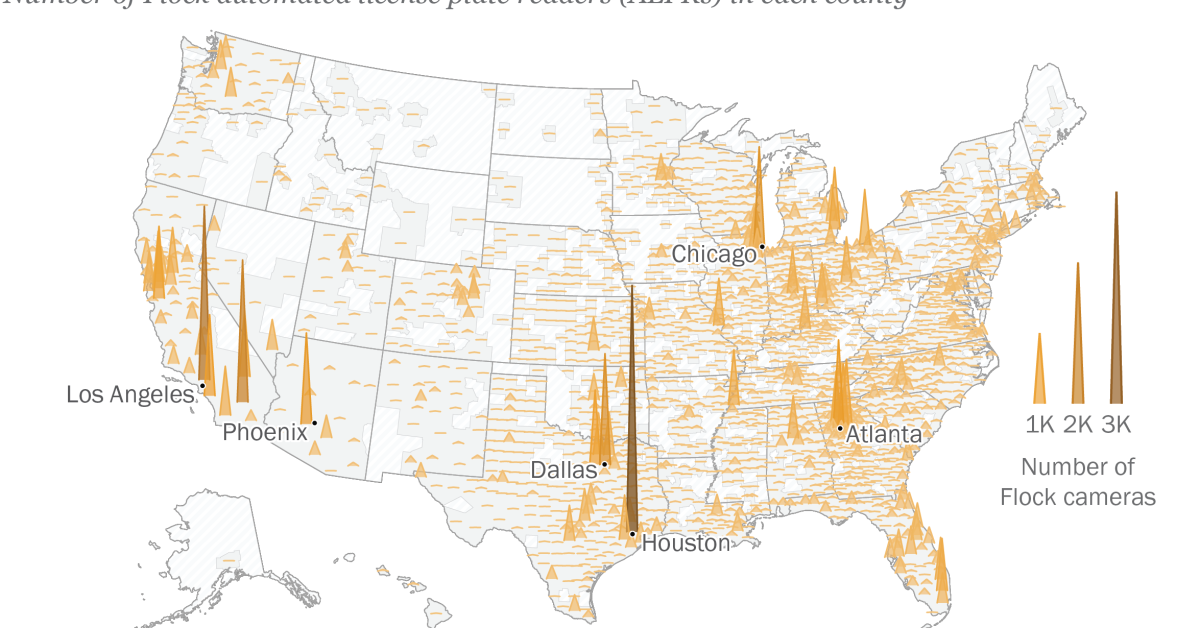
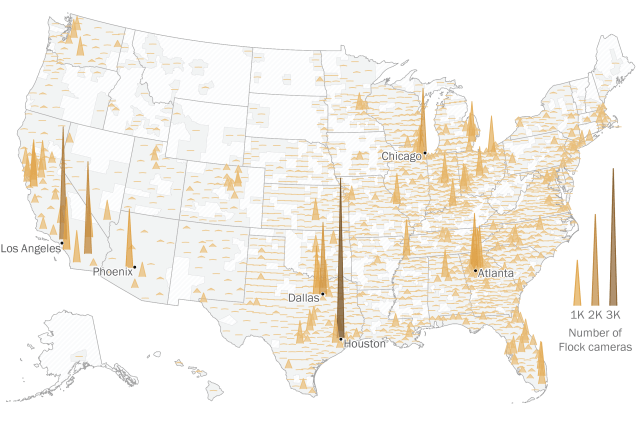
Roughly half of all identified Flock cameras are concentrated in just five states: California, Texas, Georgia, Florida, and Ohio. This concentration correlates heavily with urban development, with approximately 80% of all units installed in metropolitan areas. In these densely populated corridors—such as the Atlanta and Houston metro regions—it is nearly impossible to traverse a city without being captured by multiple cameras.
The data reveals a stark reality for residents in high-density zones:
- Georgia leads the nation with 80 cameras per 100,000 residents.
- Texas hosts a staggering 15,318 cameras, the highest raw count in the country.
- Urban vs. Rural: The divide is clear. While rural counties may have few to no cameras, major counties like Harris County, Texas, and Los Angeles County, California, operate thousands, creating a "surveillance barrier" for anyone traveling through those regions.
While the company maintains that these cameras are intended to reduce crime, the socioeconomic footprint is notable. Researchers have found that Flock cameras are slightly more prevalent in lower-income neighborhoods, raising concerns about the potential for over-policing in communities that are already under high levels of scrutiny.
Discrepancies in Disclosure: The "Transparency" Gap
One of the most contentious aspects of the Flock ecosystem is the disparity in how data is managed and disclosed. Flock provides "transparency portals" for client agencies, but their use is largely optional, and the depth of information shared varies wildly.
As of September 2026, while 1,517 agencies had active portals, these only accounted for about 36% of the cameras identified by open-source mapping. This creates a "shadow network" where the ownership and usage of the remaining 64% of cameras remain opaque to the public.
Even among those that do report, the quality of data is inconsistent:
- Data Retention: While 96% of agencies disclose how long they store footage, the periods vary significantly. Although Flock recently updated its default retention policy to seven days, many agencies still opt for longer periods, keeping months of location history on hand.
- The "Sharing" Problem: Agencies that do disclose their practices report sharing data with a median of 217 other organizations. In some states like Florida and Ohio, this sharing extends across state lines with minimal oversight, essentially creating a national registry of vehicle movements.
Official Responses and Legislative Backlash
The mounting evidence of abuse—specifically cases where officers used the system for personal gain or stalking—has triggered a fierce legislative response in Washington.
In mid-2026, the "Stop Flock Abuse Act," introduced by Senator Josh Hawley, aimed to establish federal safeguards for AI-powered cameras, including strict limitations on who can access data and why. More radically, a group of House lawmakers led by Representative Alexandria Ocasio-Cortez has introduced legislation that would effectively ban the use of such mass-surveillance tools at the federal level, arguing that the civil liberty costs far outweigh the investigative benefits.
Flock Safety has responded to these pressures by tightening its internal guardrails. The company has moved to replace open-text search fields—which allowed officers to justify a search with vague or non-existent reasons—with standardized drop-down menus. They have also promised to mandate a valid case number for all non-emergency searches by the end of 2026. However, critics argue these are superficial fixes to a systemic problem of "mission creep," where a tool designed for finding stolen cars becomes a tool for tracking the daily lives of innocent citizens.
Implications: The End of Anonymity?
The implications of this technology are profound. Historically, the "right to be let alone" was protected by the practical difficulty of tracking an individual. It required physical tailing, which was expensive and manpower-intensive. Today, that barrier has vanished.
If an individual passes five Flock cameras on their way to work, their entire route is reconstructed in a centralized database. If that data is shared with hundreds of other agencies, the subject of that tracking is effectively under surveillance by every law enforcement entity in the region.
The investigative utility is undeniable—law enforcement agencies credit the cameras with identifying suspects in everything from package theft to high-stakes homicides. Yet, the price of this efficiency is the total loss of anonymity in public space. As the number of cameras continues to grow, society must grapple with a fundamental question: Is the convenience of automated policing worth the cost of a society where one’s location is always known to the state?
For now, the expansion continues. As we look toward 2027, the battle over the "digital dragnet" is likely to move from city councils and statehouses to the federal courts, where the Fourth Amendment’s protection against unreasonable search and seizure will be tested against the capabilities of 21st-century technology. The cameras are watching, and for the first time in history, they have the memory to remember exactly what they saw.