In the era of information overload, the credibility of public opinion research rests entirely on the transparency and rigor of its methodology. As Pew Research Center continues to track the pulse of the American public, the American Trends Panel (ATP) stands as a cornerstone of national demographic and social analysis. This report provides an in-depth exploration of the methodology behind Wave 195, a nationally representative survey conducted in June 2026, which serves as a benchmark for understanding shifting attitudes toward complex socio-technical issues, including the role of artificial intelligence in modern healthcare.
The Foundation of Representative Polling: Main Facts
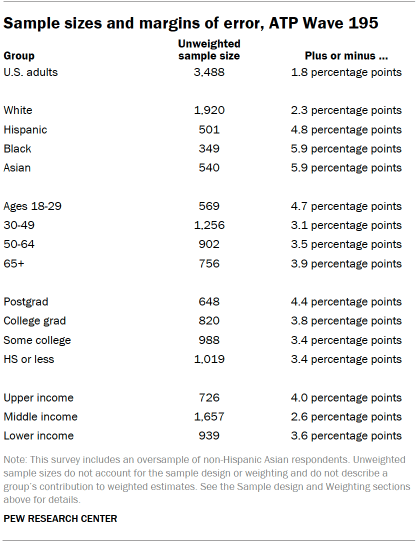
Wave 195 of the American Trends Panel represents a sophisticated effort to capture the diverse voices of the United States. Conducted between June 22 and June 28, 2026, the survey successfully engaged 3,488 panelists out of 4,069 sampled, resulting in an impressive survey-level response rate of 86%.
The integrity of this data is anchored by its reliance on a nationally representative panel. By utilizing address-based sampling (ABS) and rigorous statistical weighting, Pew Research Center ensures that the findings reflect the broader population of non-institutionalized adults in the U.S. aged 18 and older. A key feature of this specific wave was the intentional oversampling of non-Hispanic Asian adults. This strategic decision was made to ensure that the unique perspectives of this demographic—often obscured in smaller, generalized samples—could be analyzed with high precision. These oversampled responses are subsequently weighted to mirror their accurate proportions within the national demographic landscape, maintaining the survey’s overall statistical balance.
With a margin of sampling error for the full sample of plus or minus 1.8 percentage points, the results provide a robust framework for drawing conclusions about national sentiment. The operation was managed by SSRS, a research firm specializing in high-quality survey execution, utilizing both online platforms (n=3,362) and, for a smaller subset, live telephone interviews (n=126).

A Timeline of Engagement: Chronology of the Field Period
The precision of a survey is determined not just by the questions asked, but by the rhythm of data collection. The methodology for Wave 195 was executed with a staggered, multi-channel approach to maximize reach and minimize non-response bias.
Phase 1: Preparation and Pre-Notification
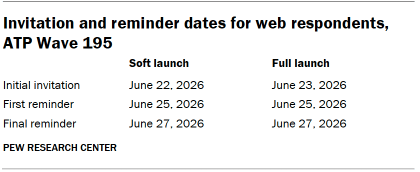
Before the official launch, preparatory work ensured the technical infrastructure was sound. For telephone participants, pre-notification postcards were mailed on June 18, 2026, setting the stage for direct contact. For online respondents, postcards were mailed on June 22, the same day the survey window officially opened.
Phase 2: The Soft Launch (June 22)
To ensure the questionnaire’s logic and the digital interface functioned correctly, a "soft launch" was conducted on June 22. Sixty online panelists and a small group of telephone participants were invited to test the system. This phase acted as a final diagnostic, allowing the research team to verify that the randomization of questions and the flow of the web application were flawless.
Phase 3: Full Deployment (June 23–28)
Following the successful validation of the soft launch, the full-scale deployment began on June 23. Online panelists were engaged via email invitations and, where consent was provided, via SMS text messages. To maintain high response rates, participants were offered post-paid incentives—ranging from $5 to $20—in the form of digital gift codes or checks. This tiered incentive structure is specifically designed to encourage participation among harder-to-reach demographics, thereby reducing potential coverage bias. Throughout this period, phone-based participants were subjected to up to six contact attempts by trained interviewers, ensuring that even those less active online were given an opportunity to voice their opinions.
Rigorous Quality Control: Supporting Data
Data collection is only as good as the screening processes that follow. The research team implemented a two-tiered approach to data quality:
- Technical Validation: Before the survey went live, researchers performed extensive testing on both PC and mobile platforms. The data logic was vetted using SPSS, confirming that all randomized paths were functioning correctly.
- Satisficing Detection: Once the data was collected, researchers conducted a comprehensive audit to identify "satisficing"—a phenomenon where respondents provide low-effort answers. Indicators included skipping questions at high rates or exhibiting "straight-lining" (repeatedly selecting the first or last option). As a direct result of this audit, two respondents were excluded from the final dataset, ensuring the integrity of the remaining 3,488 entries.
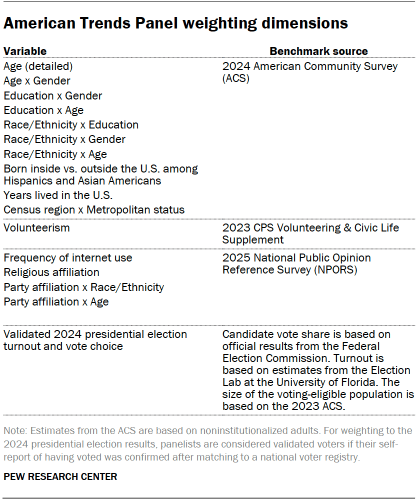
Furthermore, the weighting process for Wave 195 was multi-stage. It began with a base weight reflecting the initial probability of recruitment into the ATP. This was then adjusted to account for non-response and panel attrition, calibrated against population benchmarks from the U.S. Census Bureau. Finally, the weights were trimmed at the first and 99th percentiles to mitigate the impact of extreme values, which can otherwise distort statistical precision.
Institutional Insights: Official Responses and Expert Oversight
Pew Research Center’s approach to the American Trends Panel is a testament to the evolving nature of survey methodology. Since transitioning from landline/cellphone random-digit dialing to address-based sampling (ABS) in 2018, the Center has consistently refined its protocols.
In its official commentary regarding the Asian adult sample, the Center remains transparent about the limitations of the data. While the sample size of 540 Asian adults allows for meaningful analysis, the reliance on English-speaking respondents means it may not fully capture the nuance of non-English-speaking communities within that demographic. By explicitly noting this, the Center provides researchers and the public with the necessary context to interpret the findings responsibly, rather than overstating the scope of the results.
Additionally, the Center’s approach to economic data—adjusting family income for household size and regional cost-of-living differences—demonstrates a commitment to realism. By providing the examples of Pine Bluff, Arkansas, and San Francisco, California, the Center illustrates how it normalizes data to make "apples-to-apples" comparisons. This methodology acknowledges that a dollar in the San Francisco Bay Area holds significantly less purchasing power than in rural Arkansas, a distinction often ignored in more simplistic economic surveys.
Broader Implications: Why This Methodology Matters
The methodology of Wave 195 has profound implications for how we understand contemporary societal trends. In an age where digital misinformation is rampant, the "gold standard" of survey research must be both transparent and adaptable.
The Power of Longitudinal Panels
By maintaining a consistent, long-term panel, the ATP allows researchers to track shifts in individual attitudes over time, rather than relying on a series of disconnected, "snapshot" surveys. This longitudinal approach is essential for identifying whether a change in public opinion is a transient reaction to a news event or a fundamental, long-term shift in societal values.
Mitigating the Digital Divide
By offering multiple modes of participation—both online and via live telephone—the ATP actively combats the digital divide. While the vast majority of participants (n=3,362) chose the web interface, the inclusion of 126 phone-based participants ensures that those without reliable internet access or high digital literacy are not systematically excluded from the national conversation.
The Ethics of Incentivization
The use of differentiated incentives is a critical component of modern social science. By providing higher compensation to groups that are traditionally harder to reach, the Center minimizes the "self-selection bias" that plagues many online polls, where only the most politically motivated or technologically savvy individuals tend to participate.
Transparency as a Policy
Ultimately, the meticulous documentation of every stage—from the initial mailing of pre-incentives to the final trimming of weights—serves as an invitation to scrutiny. In an era where trust in institutions is frequently challenged, the American Trends Panel’s commitment to detailing its methodology ensures that its findings remain a reliable resource for policymakers, academics, and the public. As we move further into the 21st century, these standards of transparency will remain the primary defense against the erosion of objective, data-driven discourse.
Through the lens of Wave 195, we see not just the results of a survey, but a masterclass in the deliberate, systematic, and ethically conscious gathering of public sentiment. It is this dedication to the "how" that validates the "what," providing a stable foundation for the difficult conversations that lie ahead.