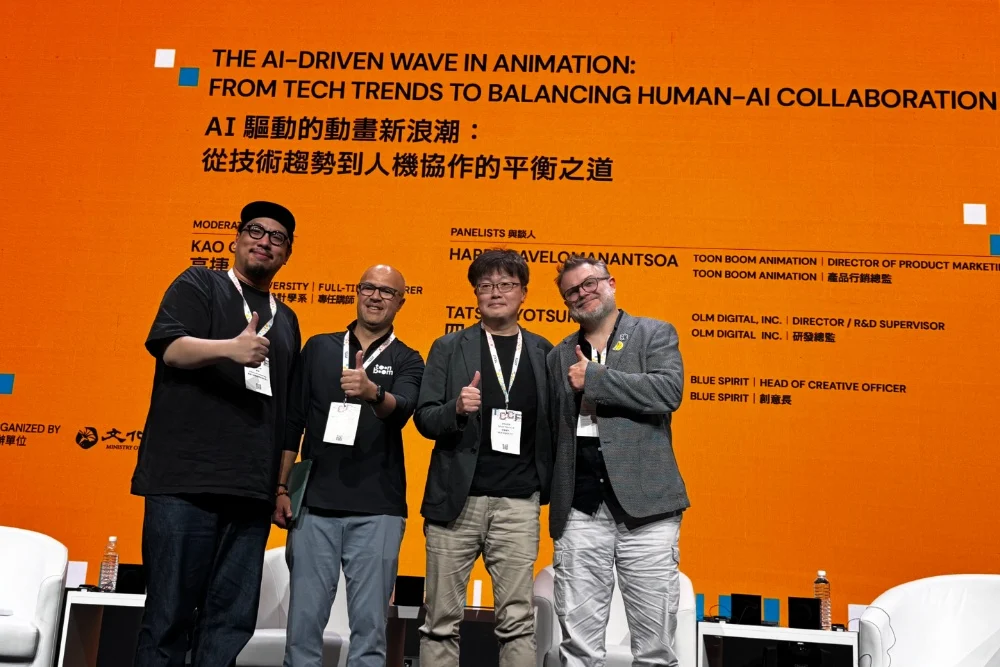
TAIPEI — As the global entertainment industry grapples with the disruptive and often controversial arrival of artificial intelligence, the studio behind the legendary Pokémon anime series is charting a pragmatic path forward. At the Taiwan Creative Content Fest (TCCF) in Taipei, OLM Digital board director and Chief Technology Officer Yotsukura Tatsuo detailed a proprietary, production-ready AI coloring tool designed not to replace human artists, but to absorb the grueling, mechanical labor that drains studio resources.
The unveiling comes at a pivotal crossroads for traditional animation. While Japanese powerhouses like OLM are engineering surgical technological interventions to alleviate crushing industry-wide workloads, Western counterparts face strict platform-imposed boundaries, highlighting a profound philosophical and operational divide in how global studios view the future of storytelling.
Main Facts
The core innovation presented by OLM—the renowned Japanese animation powerhouse responsible for the Pokémon television series and theatrical films, as well as hits like Beyblade, Hanakappa, and The Apothecary Diaries—is a targeted coloring tool that bypasses the need for massive, generalized training datasets.
Instead of scraping the internet or relying on generic generative models, OLM’s system learns a specific show’s distinct aesthetic directly from the source. An artist manually colors just three hand-painted frames. The AI system analyzes these samples to absorb the production’s exact line shapes and color palettes in roughly 90 seconds. Once calibrated, it colors each subsequent frame in about 15 seconds.
"Strictly speaking, it isn’t generative AI," Yotsukura explained to attendees at TCCF. Because the model trains exclusively on a single production’s own assets, no external intellectual property is exploited. Furthermore, the tool is dynamic: when a new character or creature—such as a fantasy dragon—is introduced, the system adapts instantly.
At the proof-of-concept stage, OLM estimates the tool has successfully cut the painting workload by approximately 30%. While human checkers still review every colored frame, the overall bottleneck of base coloring is dramatically reduced.
This technical breakthrough is part of a broader industry push. Canadian software developer Toon Boom Animation is tackling the same production bottleneck through Ember, its dedicated AI suite. According to Toon Boom product marketing director Harry Ravelomanantsoa, a beta version of Ember’s coloring tool has wrapped up, with automated in-betweening tools slated for beta release soon. Demonstrating the staggering efficiency gains, a Manila-based studio that tested Toon Boom’s coloring tool managed to compress the painting time for a 90-second scene from an exhausting 15 hours down to a mere two or three minutes.
Chronology of the Innovation
The development of OLM’s coloring system is rooted in structured government-backed research and long-term technological evolution within the anime sector.
- Pre-Project Phase: Recognizing chronic labor shortages and swelling production timelines, OLM’s rare in-house R&D division began exploring how localized machine learning could safely integrate into traditional anime pipelines without disrupting established studio workflows.
- December 2023 – February 2025 (The GENIAC Initiative): Yotsukura led ANIMINS, a intensive 15-month research project under GENIAC, a generative AI program overseen by Japan’s Ministry of Economy, Trade and Industry (METI). The initiative analyzed how anime creators could practically harness AI tools. The project successfully wrapped up in February 2025, yielding the proof-of-concept coloring technology.
- November 6–9, 2025 (TCCF Debut): OLM formally showcased the results of the ANIMINS project at the Taiwan Creative Content Fest (TCCF) held at the Taipei Nangang Exhibition Center, coinciding with the 2026-27 Pokémon Asia Championship Series held on a lower floor.
- Late 2025 & Beyond: Alongside ongoing software testing, OLM has begun experimenting with AI for in-betweening and intelligent production management agents, while software giants like Toon Boom near the rollout of their own commercial suite betas.
Supporting Data and Technical Realities
To fully understand the weight of OLM’s innovation, one must examine the operational realities and metrics governing modern animation production.
OLM employs approximately 600 staff members distributed across studios in Japan, Malaysia, Thailand, and the United States. Maintaining creative consistency across international teams working on massive franchises requires meticulous coordination. According to Yotsukura, the new coloring tool’s accuracy scales directly with human input: the more frames an artist manually paints at the outset, the more precise the AI’s output becomes.
However, bridging the gap between an impressive AI demonstration and production-ready reality remains a formidable hurdle. Yotsukura likened the phenomenon to gacha—Japanese capsule-toy machines where a turn costs roughly JPY500 ($3.30), a price point he noted is roughly equivalent to an AI generation credit.
"AI gets close enough to 80% to raise expectations," Yotsukura observed. "Raising it from there to 90 or 100% turns into work so hard it can make you heartsick."
While hobbyists might accept an 80% success rate, professional animators require absolute fidelity—returning their specific direction 100% of the time while permitting granular corrections. Anime is profoundly sensitive to color continuity; minor, imperceptible shifts in RGB values engineered by automated image-editing tools can ruin the cohesive look of a scene, even if the final image looks superficially fine.
Ravelomanantsoa summarized the ideal division of labor: "The creative stays with the artist, and the mechanical time goes to AI, to Ember." Yotsukura echoed this sentiment, emphasizing that true artistic innovation—the emotional resonance of cinematic frames and the visionary ideas behind hit shows—must always originate from human minds.
Official Responses and Studio Perspectives
The integration of artificial intelligence has exposed a distinct philosophical rift between Eastern and Western animation houses, heavily influenced by corporate policy and regional production models.
OLM and the Eastern Pragmatic Approach
For OLM, which operates under fixed budgets and joins productions only after financial parameters are set, AI is not viewed as a cost-cutting mechanism to downsize staff. Instead, it is embraced as a tool to expand creative freedom within existing budgets.
"A year or two ago, the question was how many staff AI could replace," Yotsukura said. "Now it is shifting toward new shots that AI tools made possible."
Looking beyond coloring and in-betweening, OLM is partnering with startup alumni from the GENIAC project to develop anime-specific AI agents. These systems could assist new directors or production managers onboarding onto long-running series—such as a show that has aired for a decade or more—by recalling a director’s original vision for a specific cut. Furthermore, these agents could streamline approvals and license management for secondary merchandising and distribution, which Yotsukura identified as the most revenue-critical pillar of the business.
Western Resistance and Compliance: Blue Spirit
In sharp contrast, Western studios tied to major American streaming platforms face rigid regulatory landscapes. Charles Beirnaert, Chief Creative Officer of French animation studio Blue Spirit (the creative force behind Netflix’s Blue Eye Samurai), revealed that his studio utilizes zero AI on that specific project.
"We’re not allowed to use AI for the Netflix projects," Beirnaert stated. Although Blue Spirit routinely inquires at what stage AI might be permitted, the answer remains a blanket rejection.
This aligns with stringent platform rules; Netflix’s published production guidelines for partners require transparent disclosure of any intended use of generative AI, with explicit written approval mandated before any generative material can appear in a final product. On Amazon projects, by contrast, Blue Spirit is permitted to use AI solely for pre-visualizing characters and robots, ensuring none of it reaches the final rendered screen.
Outside of strict client mandates, Beirnaert’s team has independently tested AI on a greenlit conventional CG series. While a traditional pilot required a team of 20 people working for three months, a single person using experimental AI tools managed to recreate the modeling, layout, and animation workflow within days. Although the AI-generated animation fell short of human standards, the background art surpassed expectations.
"For me, AI is not meant to replace animators," Beirnaert asserted. "The day every animator is replaced, I will change job and do something else."
The two studio leaders also diverged on the financial implications of AI. Beirnaert estimated that AI could theoretically save roughly €1 million on an €8 million budget, potentially helping stalled projects bridge their financing gaps. Yotsukura countered that OLM’s structural position in Japan’s anime ecosystem renders such budget-slashing calculations irrelevant, focusing instead on efficiency and artistic enhancement.
Moderator Kao Chieh, a lecturer at Shih Chien University, attributed these differing perspectives to an inherent divergence between Eastern and Western animation industries.
Implications for the Future of Animation
As the debate settles, industry leaders are increasingly recognizing that total abstinence from new technologies is no longer viable. Yotsukura compared the arrival of artificial intelligence to the introduction of 3DCG, which faced fierce skepticism and took roughly two decades to achieve universal acceptance within the anime industry.
"Twenty years ago, I kept rejecting it, saying, ‘How could this ever be used in anime?’ Now it’s unthinkable for anime not to have 3DCG," Yotsukura reflected. He predicts that AI adoption will move at an exponentially faster pace because its foundational output quality is already remarkably high from day one.
Ultimately, OLM views technology and human creativity not as opposing forces, but as a pair of driving wheels propelling the industry forward. With labor shortages threatening the sustainability of Japan’s booming anime output, targeted, non-generative AI tools offer a lifeline—absorbing the mind-numbing mechanics of production while preserving the irreplaceable soul of human artistry.
"I think ‘not using AI’ is probably no longer an option from here on," Yotsukura concluded.