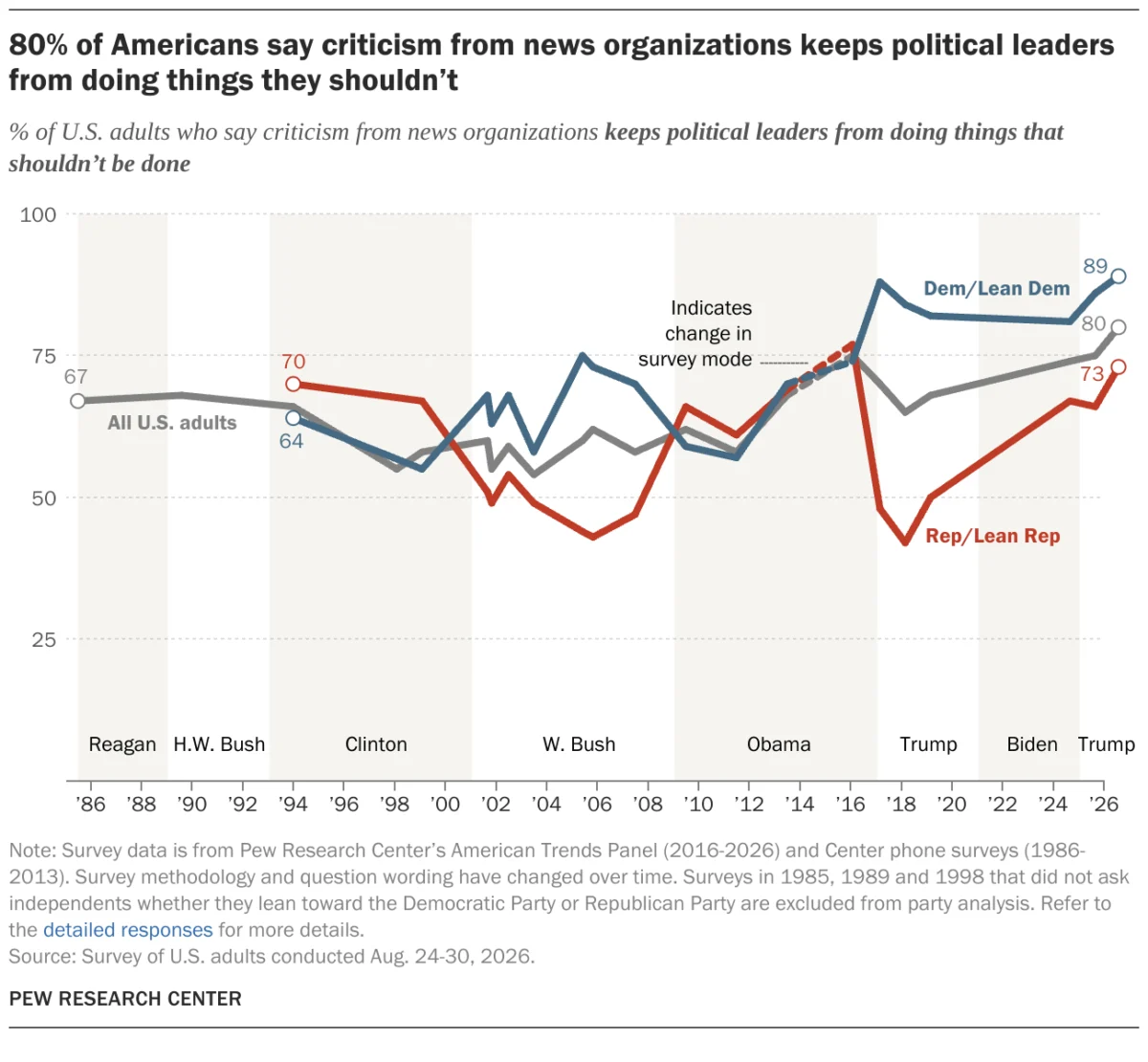
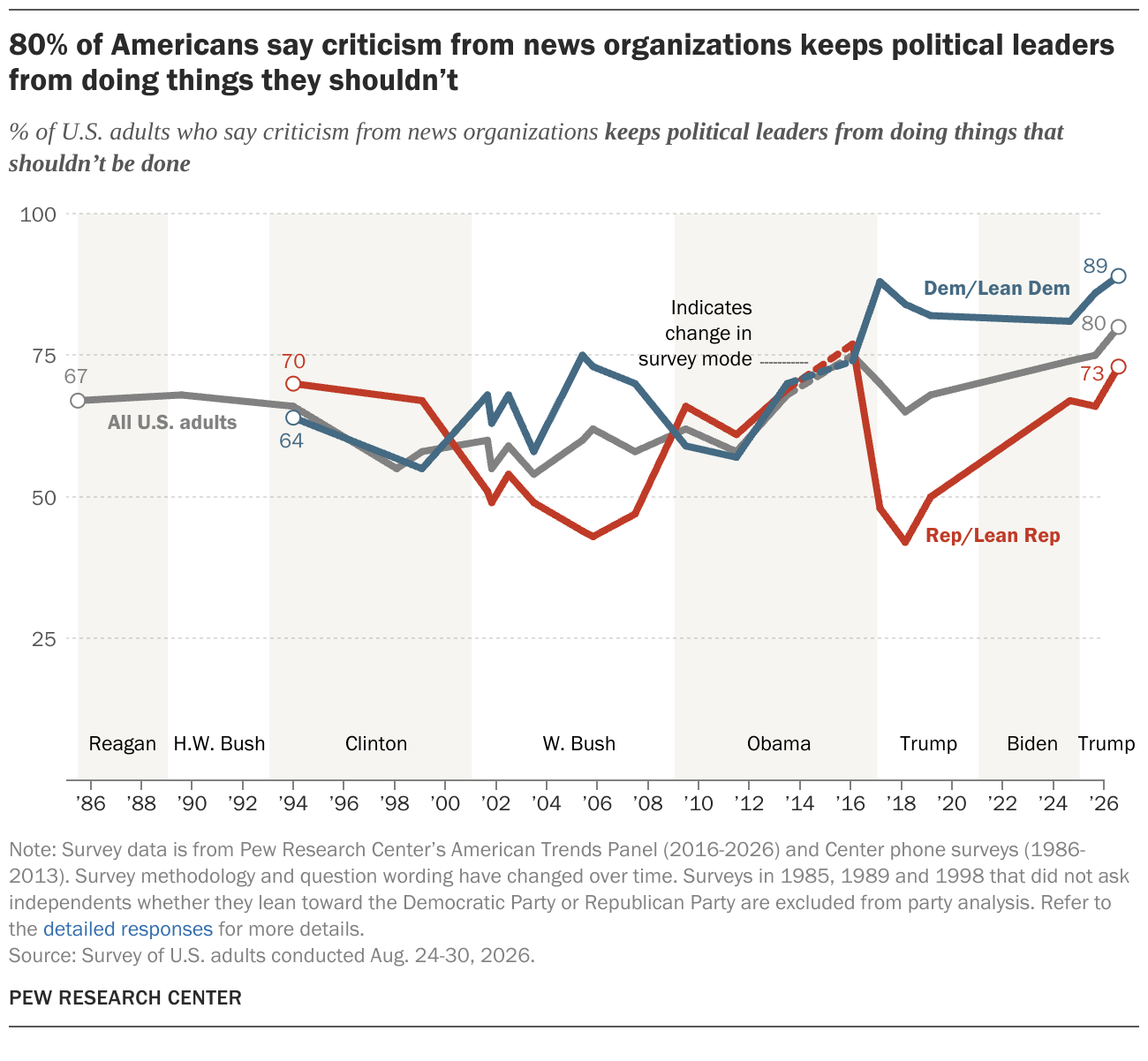
In a polarized era defined by intense partisan skepticism and rapidly shifting digital landscapes, one bedrock principle of American democracy appears to be experiencing a resurgence in public favor: the role of the press as a necessary check on political power. According to a comprehensive survey conducted by the Pew Research Center in late August 2026, a robust 80% of American adults now believe that critical news reporting plays a vital function in preventing political leaders from overstepping their bounds.
This figure marks a notable climb from the 75% recorded in September 2025. While the concept of the media as a "watchdog" has historically been a flashpoint for ideological debate, the latest data suggests a broadening consensus. Today, the belief that journalistic oversight keeps officials from engaging in malpractice is shared by overwhelming majorities across the political spectrum—a development that challenges recent narratives regarding the total erosion of institutional trust.
The Evolution of the Watchdog Role: A Chronology of Sentiment
To understand the current climate, one must look at the historical trajectory of public sentiment. Since the mid-1980s, the Pew Research Center has tracked how Americans perceive the influence of the news media on governance. Throughout the 1990s and early 2000s, this metric fluctuated, often mirroring the political volatility of the time.
In 1985, roughly 67% of Americans saw the media as a positive force for accountability. By 2011, a year marked by economic recovery efforts and significant political friction, that number dipped to 58%. The following decade saw even more dramatic oscillations, often tied to which party occupied the White House.
Historically, supporters of the party out of power have been more inclined to view the media as a necessary check on the executive branch, while those aligned with the sitting president have frequently viewed such criticism as obstructionist or biased. However, the data from the past two years suggests a deviation from this traditional partisan cycle. Even with a Republican in the White House, a substantial majority of Republicans now acknowledge the importance of media oversight, signaling a potential shift in how voters across the aisle perceive the necessity of external accountability.
Parsing the Data: Partisan Alignment and the 2026 Landscape
The August 2026 survey, which polled 5,166 U.S. adults via the American Trends Panel, provides a granular look at how these perceptions break down.

The Partisan Breakdown
- Democrats and Democratic-leaning Independents: 89% currently believe that news media criticism prevents leaders from acting improperly. This represents a significant solidification of the view that the press serves as a vital safeguard.
- Republicans and Republican-leaning Independents: 73% of this group now express the same sentiment. Perhaps most surprising is that this figure has risen since 2024 (when it stood at 67%), even as the party transitioned from the opposition to the executive branch under President Donald Trump.
These figures are particularly striking when compared to the mid-2010s. In 2018, for instance, only 42% of Republicans held this view, highlighting a massive swing in sentiment within the conservative base over the last eight years. Today, views on the media’s watchdog role appear remarkably consistent across age demographics and internal ideological factions, suggesting that the "watchdog" identity of the press is being re-evaluated not just as a political weapon, but as a systemic necessity.
The Paradox of Trust and Scrutiny
Perhaps the most compelling finding in the 2026 data is the correlation between the validation of the media’s watchdog role and an uptick in general trust. For years, the discourse has been dominated by the "death of trust" in media, fueled by the rise of misinformation and echo chambers. However, the latest findings indicate that trust in both national and local news organizations has risen slightly since 2025.
This is not to say that the public is uncritical. A significant 16% of respondents maintain that media criticism often hinders political leaders from effectively doing their jobs—a sentiment that reflects the lingering tension between the desire for accountability and the frustration with perceived political paralysis. Yet, when balanced against the 80% majority, it becomes clear that the public appetite for transparency currently outweighs the desire for unchecked executive action.
Official Perspectives and the Political Climate
The role of the media in the capital has long been a source of tension for those in the halls of power. In September 2025, Speaker of the House Mike Johnson, speaking to reporters at the U.S. Capitol, underscored the ongoing debate regarding the press’s role. While politicians frequently clash with the Fourth Estate, the public’s insistence on the "watchdog" function places a unique pressure on political leadership to remain transparent.
The current political environment, characterized by intense legislative battles and global instability, seems to have heightened the public’s sensitivity to potential executive overreach. When the citizenry feels that the political process is opaque, the reliance on the media to "shine a light" on backroom dealings becomes more pronounced. This sentiment has become a bipartisan common denominator, even in an era of otherwise extreme polarization.
Implications for the Future of Journalism and Democracy
The implications of these findings are profound for both the news industry and the political establishment. For news organizations, the data provides a mandate to prioritize investigative journalism and rigorous fact-checking. The public is not asking for "more news," but specifically for "more accountability."
1. The Stability of Democratic Institutions
If the majority of Americans, regardless of their political identification, agree that the media serves as a necessary check on power, it provides a psychological buffer for democratic institutions. It suggests that the electorate values the process of scrutiny, which is a prerequisite for a functioning republic.
2. A Call for Non-Partisan Reporting
The fact that both Republicans and Democrats are increasingly leaning into the idea of a watchdog press suggests that partisan-coded media may eventually face a market correction. Audiences appear to be moving toward outlets that prioritize factual oversight rather than ideological validation, as they view the role of the reporter as a protector of the public interest rather than a participant in the political fray.
3. Challenges Ahead
Despite the positive trajectory of these numbers, the industry remains vulnerable. The financial instability of local news outlets, the rise of AI-generated content, and the persistent threat of disinformation campaigns mean that the "watchdog" is currently under-resourced. The survey shows that while the desire for a watchdog is high, the capacity of the media to fulfill that role is constantly being tested by economic and technological pressures.
Conclusion: A Renewed Social Contract?
The 2026 Pew Research Center survey serves as a vital barometer of the American consciousness. By moving past the cyclical swings of partisan blame, the data reveals a fundamental truth: Americans understand that democracy is not a self-correcting machine. It requires constant observation.
While the "watchdog" role of the press will always be subject to debate and criticism, the fact that 80% of the public now views this scrutiny as essential is a significant indicator of democratic health. As the nation moves forward, the relationship between the press, the government, and the governed will continue to evolve, but this latest data suggests that the demand for accountability remains the most enduring feature of the American political identity. Whether the news media can rise to meet this renewed expectation of trust and oversight remains the defining challenge for the coming decade.